
How to Read a Pokémon Card: What the Numbers and Symbols Actually Mean
Crack the code on the tiny numbers and symbols printed on every Pokémon card — in about three minutes.
By THM · 5 min read
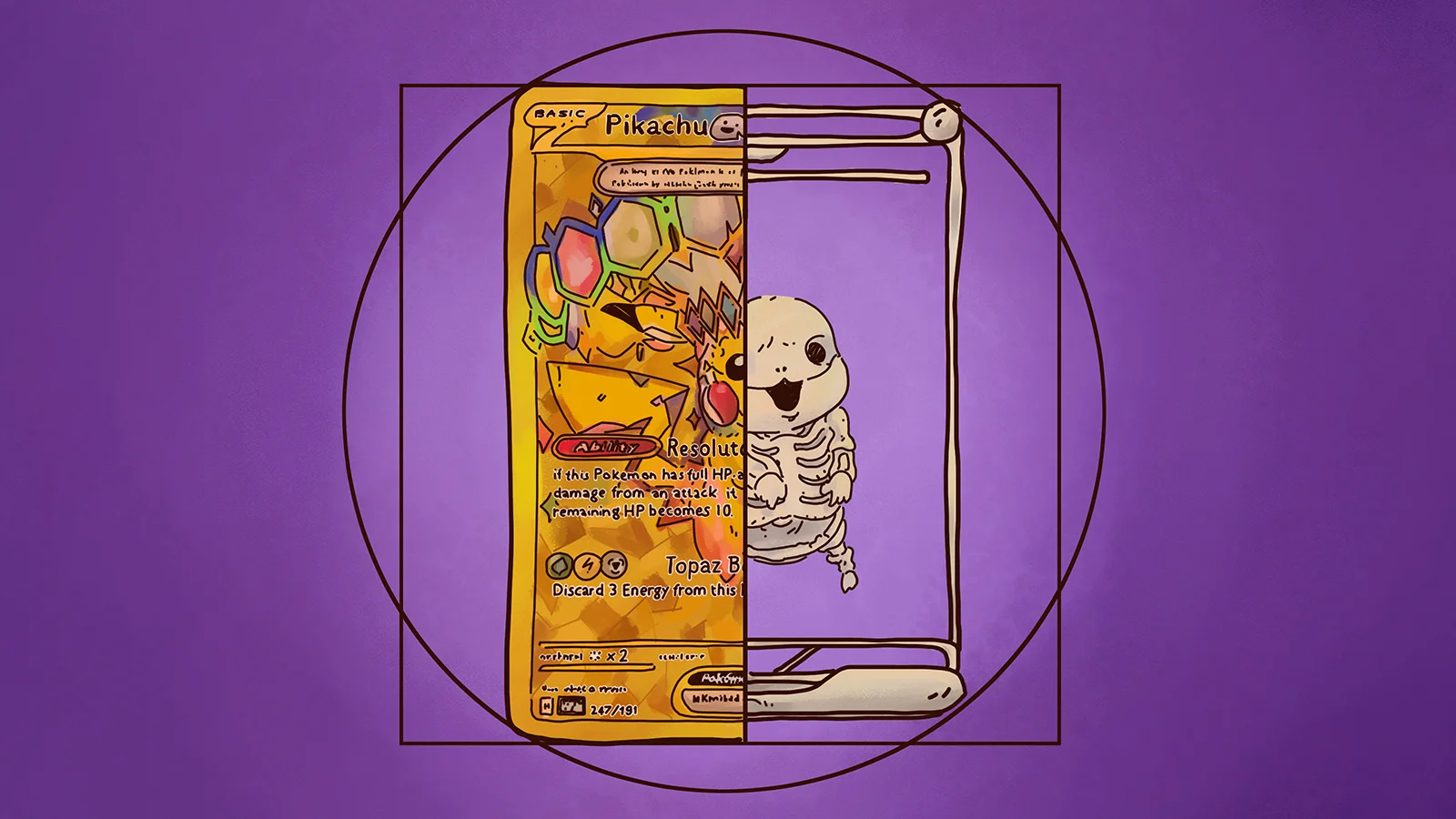
Pick up any Pokémon card and you'll see a bunch of tiny numbers and symbols crammed around the edges. Most people never bother working out what they mean. But once you crack the code, you can look at a card and tell which set it's from, how rare it is, and roughly how old it is — all in a few seconds, without looking anything up.
I'm a comics guy first, and this reminded me of learning to read the little print in the corner of a comic — the indicia — that tells you the issue, the date, the printing, all that. Looked like noise until someone showed me what to look for. Same deal here. Let me show you what to look for.
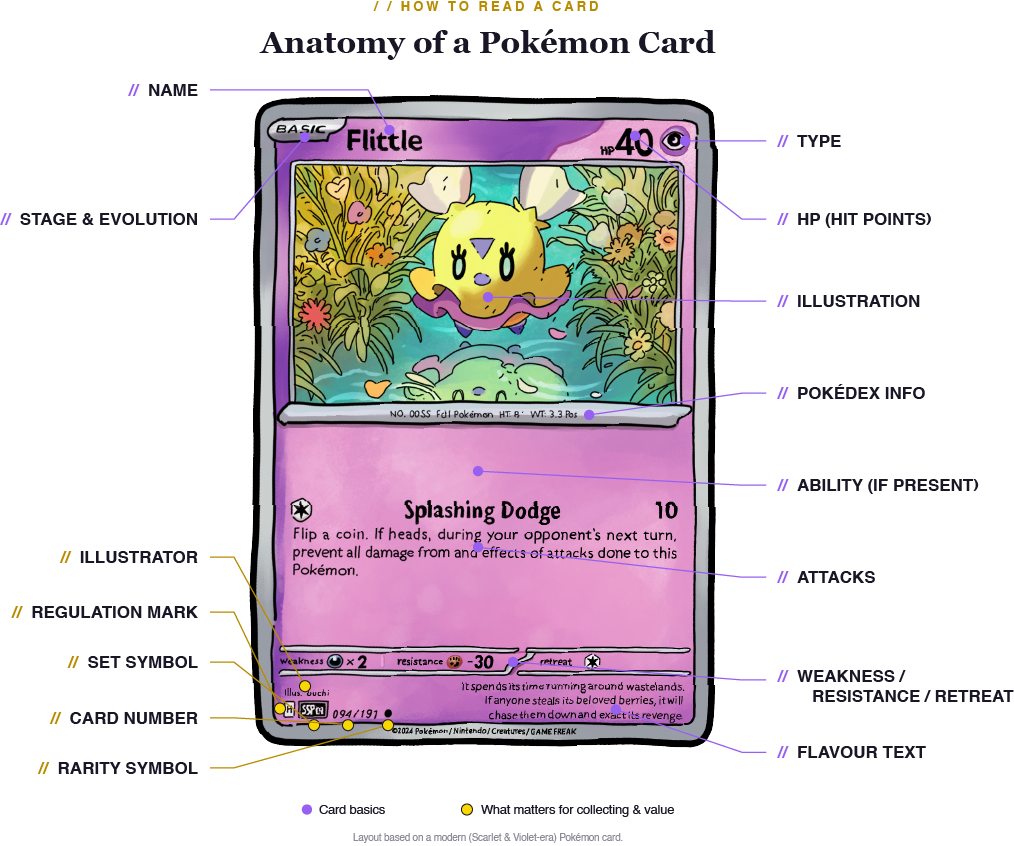
Almost everything you need is along the bottom of the card.
The card number (like 25/102)
This is the big one. Near the bottom of the card you'll see two numbers with a slash between them, like 25/102.
The first number is the card's spot in the set. So this is card number 25.
The second number is how many cards are in that set. So this set has 102 cards.
Card 25 of 102. Easy. This is how you keep track of which cards you've got and which you still need.
The secret rare trick (this one's worth knowing)
Here's a neat one that confuses heaps of beginners. Sometimes the first number is bigger than the second. You'll see something like 238/191.
Wait — how can it be card 238 of 191? That makes no sense, right?
It does once you know the rule: if the first number is higher than the set total, you've got a secret rare. These are special cards printed on top of the normal set — the chase cards, the fancy full-art ones, the gold ones. They're some of the rarest and most wanted cards going.
So next time you pull a card, glance at those two numbers. If the first is bigger than the second, you've got something special. Always check the numbers.
The set symbol (which set it's from)
Right near the card number there's usually a little picture or icon. That's the set symbol, and every Pokémon set has its own.
The thing is, there are well over a hundred sets now, so nobody memorises them all — not even the pros. The symbol's job isn't to be memorised. It's there so you can match it up against a set list and find exactly which set your card belongs to.
(Fun one for the trivia pile: the very first set, Base Set from 1999, has no set symbol at all. If a card has no symbol, that's how you know it's Base Set. Every set since has had one.)
This is exactly what the set checklists on this site are for — match your card to its set, and you can see the whole list, tick off what you own, and confirm exactly what you're holding.
The rarity symbol (how rare it is, sort of)
Next to the set symbol and card number, there's another small symbol. This one tells you the card's rarity. The three you'll see most often are:
- A circle = Common. The everyday cards.
- A diamond = Uncommon. A step up.
- A star = Rare. The good slot in a pack.
That's the classic system, and it's been around forever. The newer Scarlet & Violet sets added a bunch more symbols on top of these for the fancier cards — things like double stars and gold stars. Three gold stars, for example, is a Hyper Rare, right at the top end.
One honest word of warning, though: the rarity symbol doesn't equal value. A "rare" card from a set nobody cares about can be worth less than an "uncommon" featuring a popular Pokémon everybody wants. Rarity tells you how hard a card was to pull. The market decides what it's actually worth, and the two don't always line up. Art and popularity drive price as much as the symbol does — sometimes more.
The regulation mark (a quick age check)
On newer cards you'll spot a single letter in a little box near the bottom — something like G or H. That's the regulation mark.
It's mostly there for tournament players (it controls which cards are legal in official play, and they rotate the older ones out over time). But it's handy for collectors too, because it's a quick way to tell roughly how new a card is. These only started showing up around 2020, so if a card has one, it's reasonably modern. No letter at all usually means it's older.
A few extra bits worth a glance
While you're down there, a couple more things tell you a lot:
- Holo vs reverse holo. A holo card has the shiny foil just in the artwork box. A reverse holo has the shine everywhere except the artwork. Holos are usually the harder, more wanted ones.
- Texture. Run your finger over the fancier cards. A lot of the premium ones have a bumpy, textured feel you can actually feel. That's a good sign you've got something special.
- Vintage stamps. On old cards, look for a "1st Edition" stamp or a "shadowless" look (no shadow behind the art box). Both make those old cards worth more.
Put it all together
Once you know the code, reading a card becomes a three-second habit:
- Check the two numbers — and see if the first is bigger than the second (secret rare!).
- Find the set symbol to work out which set it's from.
- Glance at the rarity symbol for a rough idea of how rare it is.
- Spot the regulation mark to get a sense of how old it is.
That's genuinely most of what you need to identify almost any card you'll come across.
And when you want to be 100% sure what you're holding — and start keeping track of it — drop the set into the checklists here. Match the symbol, find the card by its number, tick it off, and you're away. Beats squinting at tiny symbols and guessing.
Use the set checklists to confirm exactly which set your card belongs to — and tick it off while you're there.
Match your card to a set →More guides
 GUIDE
GUIDEIs It Worth Grading Your Pokémon Cards? An Honest Take on PSA vs CGC vs SGC
6 min read
 GUIDE
GUIDEHow to Start (and Actually Keep Track of) a Pokémon Collection
5 min read
Booster Boxes vs Singles: The Honest Answer (and Why I Ignored It)
GUIDEBooster Boxes vs Singles: The Honest Answer (and Why I Ignored It)
6 min read
How Much Is My Pokémon Card Worth? An Honest Guide
GUIDEHow Much Is My Pokémon Card Worth? An Honest Guide
6 min read
What Actually Makes a Card Valuable?
GUIDEWhat Actually Makes a Card Valuable?
6 min read
How to Spot a Fake Pokémon Card (and Avoid Getting Burned)
GUIDEHow to Spot a Fake Pokémon Card (and Avoid Getting Burned)
6 min read
Where to Actually Buy Pokémon Cards (and What to Watch Out For)
GUIDEWhere to Actually Buy Pokémon Cards (and What to Watch Out For)
6 min read
How to Store and Protect Your Cards (Without Going Overboard)
GUIDEHow to Store and Protect Your Cards (Without Going Overboard)
6 min read