
What Actually Makes a Card Valuable?
Rarity is only a third of the answer. Here's what really drives what a card is worth.
By THM · 6 min read
What Actually Makes a Card Valuable?
Ask most people why a card is worth money and they'll say "because it's rare."
That's the answer everyone gives, and it's only about a third right. Rarity matters — but I've seen plenty of genuinely rare cards that nobody wants and sell for pocket change, and plenty of "common" ones that people fall over themselves to buy.
Value in this hobby is a bit more interesting than that. It comes down to four things pulling against each other, and once you can see them, you can look at almost any card and get a rough sense of where it sits.
1. Demand — the one that really runs the show
This is the big one, and it's the one people underrate.
A card is worth what someone actually wants to pay for it. That's it. That's the whole market. And what people want is not always what's rarest — it's what they love.
Charizard is the obvious example. It's not the rarest card ever printed, not by a long way. It's worth a fortune because an entire generation grew up wanting Charizard, and now that generation has jobs. Pikachu, Eevee and the Eeveelutions carry the same emotional weight.
Meanwhile, an obscure card with a tiny print run can sit there gathering dust because nobody's chasing it.
Demand beats rarity. If you remember one thing, make it that.
2. Scarcity — how many actually exist
Now, rarity does matter — it just needs demand behind it to turn into money.
Fewer copies in the world means more competition for the ones that exist. That's why you see value in:
- First editions and early print runs — fewer got made
- Secret rares — the ones numbered beyond the set total (if the first number's bigger than the second, that's what you've got)
- Promos and limited releases — event cards, small distributions
- Errors and misprints — accidents that got pulled quickly
Take a scarce card that people also badly want, and that's when the numbers go silly.
3. Condition — the multiplier
Here's where a lot of value quietly evaporates.
The same card, in different condition, can be worth many multiples more or less. A pristine copy and a played-with copy are, financially speaking, barely the same object.
What condition really means:
- Sharp corners (not soft or fuzzy)
- Clean edges (no white chipping)
- A clean surface (no scratches or print lines)
- Good centering (the art sitting evenly in its borders)
- No creases — a crease is the value-killer
Condition is a multiplier applied to everything else. A mint common is often worth more than a battered rare.
And it's why grading exists at all — a slab with a high grade on it is really just a stranger you trust vouching for the condition. (Whether it's worth paying for that is a different question — that's what our grading calculator is for.)
4. The art — the one I care about most
I'll declare my bias: I'm a comics guy and a self-taught artist, and this is the part of the hobby I love.
Some cards are worth money purely because they're beautiful. Not because they're rare, not because they're powerful in the game — because people want to look at them. The modern illustration rares and alt-arts are chased hard by collectors who have zero interest in playing and every interest in a gorgeous piece of art in a binder.
That's not a fringe thing anymore, it's a real driver of the market. There are artists whose cards carry a premium simply because their work is beloved — and if you want to fall down that hole, our artist pages let you browse by illustrator and see it for yourself.
Comics proved this a long time ago
I know this works because I watched it happen in comics for thirty years.
Take Catwoman #51. Nothing happens in it. No first appearance, nobody dies, no big event. It's just another issue — except the cover is by Adam Hughes, and it's gorgeous. That cover alone drove the book to hundreds of dollars. People aren't buying a story. They're buying an image they want to own.
Batman #423 is the same deal — a Todd McFarlane cover so iconic that the book gets chased for the picture on the front, full stop.
Now compare that to Amazing Spider-Man #300. McFarlane again, and one of the most badass Spider-Man covers ever drawn — that slinky, spidery pose everyone's copied since. But that book isn't expensive because of the cover. It's expensive because it's the first full appearance of Venom, in the 25th anniversary issue. The art is the cherry on top of a card that was already valuable.
That's the difference, and it's worth understanding: sometimes the art is the value (Catwoman #51). Sometimes the art amplifies value that was already there (ASM #300). Both are real.
Pokémon works exactly the same way. Some cards are chased for what they are. Some are chased purely because the illustration is stunning. And a few — the ones that go truly silly — are both.
Art creates demand. Demand creates value. That's the whole reason there's an artist search on this site.
Putting it together
So when you look at a card and wonder what it's really worth, run the four:
- Does anyone want this? (popular Pokémon, popular art, nostalgia?)
- How many exist? (secret rare, first edition, promo?)
- What condition is it truly in? (be honest — corners, edges, surface, creases)
- Is it beautiful? (would someone want this on a shelf?)
Score well on demand and scarcity and condition, and you've got something genuinely valuable. Score well on only one, and you probably haven't.
And the part the market can't price
Here's my honest closing thought, and it's the same one I keep landing on.
Everything above tells you what a card is worth to other people. It says nothing about what it's worth to you.
My most treasured comics aren't my most valuable ones — they're three boxes of signed issues I'll never sell, kept because I love the artists who signed them. My favourite card is an old Akira promo I've never once looked up the price of.
The market has its four factors. You're allowed to have a fifth: you just love it. And no price guide in the world gets a vote on that one.
Want to see where your own cards land? Browse the set checklists, keep track of what you own with the tracker, and run anything promising through the grading calculator before you spend a cent on grading.
See where your own cards land — tick off what you own and watch the tracker keep score.
Browse the set checklists →More guides
 GUIDE
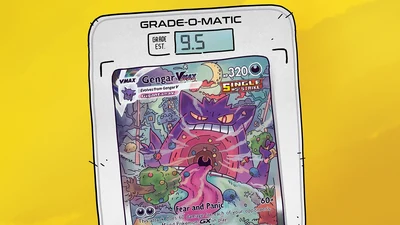
GUIDEIs It Worth Grading Your Pokémon Cards? An Honest Take on PSA vs CGC vs SGC
6 min read
 GUIDE
GUIDEHow to Start (and Actually Keep Track of) a Pokémon Collection
5 min read
Booster Boxes vs Singles: The Honest Answer (and Why I Ignored It)
GUIDEBooster Boxes vs Singles: The Honest Answer (and Why I Ignored It)
6 min read
How Much Is My Pokémon Card Worth? An Honest Guide
GUIDEHow Much Is My Pokémon Card Worth? An Honest Guide
6 min read
How to Spot a Fake Pokémon Card (and Avoid Getting Burned)
GUIDEHow to Spot a Fake Pokémon Card (and Avoid Getting Burned)
6 min read
Where to Actually Buy Pokémon Cards (and What to Watch Out For)
GUIDEWhere to Actually Buy Pokémon Cards (and What to Watch Out For)
6 min read
How to Store and Protect Your Cards (Without Going Overboard)
GUIDEHow to Store and Protect Your Cards (Without Going Overboard)
6 min read
 GUIDE
GUIDEHow to Read a Pokémon Card: What the Numbers and Symbols Actually Mean
5 min read